

 Loading...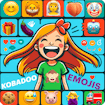









Kobadoo Emojis: remember the funny faces in the right order
Kobadoo Emojis is a visual memory game built around sequences of expressive emojis. The player watches a group of funny faces, remembers their order, and selects them in the same order during the answer phase. The images are friendly and easy to recognise, but the sequence becomes demanding when several similar expressions appear together. The challenge is to hold a changing visual list in working memory long enough to reproduce it without turning the task into a guess.
The title is an HTML5/JavaScript game released on February 1, 2022. It is presented in portrait orientation and has a community rating of 9.4. The confirmed controls are mouse on desktop and touch screen on mobile: select the emojis in the right order. The published description frames the activity as working-memory training and refers to studies about cognitive functions. Those references describe the game’s educational context, while the actual play remains a focused browser exercise in observation, order, and careful selection.
Give the sequence a shape
When the emojis appear, do not try to repeat them as an undifferentiated list. Group them into pairs or short visual phrases. A smiling face followed by a surprised face can become one small unit; a sad face followed by an angry face can become another. The exact story is personal. Its purpose is to give the order a structure that is easier to retrieve when the emojis are no longer displayed.
Use more than the emotion itself as a clue. Notice colour, eyes, mouth, accessories, or the direction of an expression. Two emojis can communicate a similar mood while still being different enough to confuse a rushed selection. A strong memory cue combines the face’s distinctive detail with its position in the sequence. If every image is remembered only as “happy” or “sad,” later rounds can expose the missing information.
On desktop, use the mouse to select the emojis once the answer phase begins. On mobile, tap the touch screen with a deliberate rhythm. Confirm the first choice before moving to the next. A fast chain of clicks can turn a memory mistake into an input mistake, especially when the emojis are placed close together. The goal is accurate order, not the smallest possible pause between selections.
Protect the first and last positions
The first emoji often establishes the route, while the last one can be forgotten because attention is spent on the middle. Give both positions a special cue. You might imagine the sequence entering a room with one face at the door and leaving through another, then place the middle emojis between them. This simple boundary helps keep the list from collapsing into a collection of expressions without direction.
When the sequence is longer, divide it into equal groups rather than trying to rehearse every emoji continuously. Recall the first group, then the second, and connect the boundary between them. If the game shows an unusual face, use it as a landmark. A distinctive emoji can anchor the sequence and make the surrounding choices easier to locate.
Do not over-rehearse by repeating the same image until the next one disappears from attention. The sequence needs balance. Look at the full group, identify the strongest differences, and build a short mental route. During the answer phase, move through that route calmly. If one emoji feels uncertain, pause long enough to check the surrounding group rather than replacing the answer with a random selection.
Use errors as information
When a selection is wrong, ask what kind of confusion occurred. Was the emoji recognised correctly but placed one position too late? Did two faces share a colour or expression? Was the first group remembered while the final group vanished? Each answer points to a different adjustment. The next attempt can focus on order, distinctive features, or the boundary between groups.
A correct sequence can also be reviewed. Notice which memory cue made it work and keep that method for the next round. The game becomes more rewarding when progress is connected to a strategy the player can repeat. A higher result is valuable, but understanding why the result improved is what makes the skill transferable across harder sequences.
Because the game runs in a browser and supports desktop and mobile input, short sessions are easy to fit into a break. One session can focus on grouping, another on distinguishing similar faces, and another on selecting with a steady touch rhythm. Varying the goal keeps the exercise fresh while preserving its central rule: observe first, choose second.
Make the portrait layout work
The portrait presentation keeps the emoji field close to the thumb on mobile, but the player should still keep the whole sequence visible during observation. Avoid covering the lower images with a hand. On desktop, keep the browser frame at a size that makes small facial details easy to distinguish. A clear display prevents visual uncertainty from being mistaken for a memory problem.
During selection, look at the emoji you intend to choose before touching it. Read the face, compare it with the mental group, and tap once. This creates a repeatable three-step action that protects against accidental selections. Mouse control follows the same principle: point, verify, click. The simple interface leaves room for deliberate play.
Kobadoo Emojis offers the appeal of a lighthearted emoji collection with the concentration of a sequence puzzle. The faces are amusing, but the order matters. Group the images, preserve the first and last positions, distinguish similar expressions, and use mouse or touch input carefully. The satisfaction comes when the final selection confirms that the entire visual route was held in mind.
A practical memory method
For a new round, divide the emojis into pairs and give each pair a quick visual label. Recall the first pair, then the next, and keep one landmark between them. When selecting, do not jump directly to the most distinctive face; start at the beginning and follow the route. If the sequence breaks, identify the pair that disappeared and strengthen that cue on the next try.
Try a second method when a pair contains two similar expressions. Compare the eyes or mouth instead of relying on the general emotion. This small change can turn two confusing faces into two separate visual objects. The game rewards attention to detail, but it does not require the player to memorise every pixel.
On a return visit, aim for clean order rather than frantic speed. Kobadoo Emojis is at its best when the player sees a short sequence once, organises it mentally, and reproduces it with confident mouse clicks or touch selections.
More Featured Games
Browse the Featured Games collection or continue with Robo-Butcher and Perimeter – Legate Edition.
Frequently Asked Questions
What is Kobadoo Emojis about?
Kobadoo Emojis is a visual memory game built around sequences of expressive emojis. The player watches a group of funny faces, remembers their order, and selects them in the same order during the answer phase. The game frame above contains the current playable version and may change when the provider updates it.
How do you control Kobadoo Emojis?
The title is an HTML5/JavaScript game released on February 1, 2022. It is presented in portrait orientation and has a community rating of 9.4. The confirmed controls are mouse on desktop and touch screen on mobile: select the emojis in the right order. Use the inputs shown by the live game, because controls can vary by device and provider version.
Does Kobadoo Emojis work on mobile?
If the current provider build exposes touch support, it can be tried in a mobile browser. Otherwise use a desktop browser and the controls shown by the frame; performance and orientation can vary by device.