

 Loading...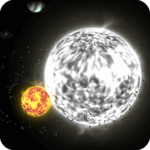






myDream Universe is the opposite of Solar Smash in one specific way: instead of blowing a planet up, you build one from scratch by eating what drifts past. You start as an asteroid barely bigger than the dust around it, and every rock you touch adds to your mass. Keep going and the asteroid becomes a moon, then a planet, then a star, and eventually something that swallows light. There is no timer and no scoreboard rushing you. The whole game is one long climb up the size chart, and the only real question is how far up it you can get before something bigger gets you first.
It is a Unity WebGL game, so give it a few seconds to load the first time. Once it is in, it runs smoothly on most laptops and on recent phones. If you are coming here from Solar Smash, the pacing will feel very different: Solar Smash is about fifteen seconds of spectacle; myDream Universe is about fifteen minutes of patience with a payoff at the end.
How to Play myDream Universe
Point with the mouse (or drag on a phone) and your body drifts in that direction. That is the entire control scheme. There is no boost button, no ability bar and no menu to manage while you play. Anything smaller than you gets absorbed on contact and adds Growth Points. Anything larger will do the same to you, so the first few minutes are mostly about reading sizes at a glance and staying on the correct side of the comparison.
Sizes are not always obvious. Two bodies that look similar can be on either side of the line, and the game does not draw a warning ring around dangerous ones. When you are not sure, go around. Losing thirty seconds of growth to a bad guess costs far more than the detour. A useful habit is to compare the other object to your own outline rather than judging it on its own: if its diameter looks like it would fit inside yours with room to spare, it is food.
Movement has inertia. You do not stop the instant you release the mouse; you coast. That matters near large bodies, because a coast that carries you into their pull is a coast you cannot cancel. Start turning away earlier than feels necessary and you will avoid most of the accidents that end early runs.
The Early Asteroid Phase
The opening is slow on purpose. Small rocks give tiny amounts of mass, so it can feel like nothing is happening for the first minute or two. Stick to the clusters of debris near your spawn point and sweep through them in loops rather than chasing single pieces across empty space. Every piece counts the same whether it was near or far, so distance travelled per piece is the number to minimise.
Once you pass moon size, the growth curve bends upward. Objects that were threats become targets, and a single one of them is worth dozens of the pebbles you started on. This is the moment the game opens up, and it usually arrives sooner than it feels like it will.
Reading the Neighbourhood
Bigger bodies exert pull. Get too close to a large planet and you will get dragged in even if you were steering away. Treat every big object as having an invisible margin around it and keep to the outside of that margin. The margin grows with the object, so a star needs far more clearance than a planet.
Comets and fast movers are a separate problem: they cross the screen quickly and can catch you from behind while you are focused on something in front. Glance at the edges of the view every few seconds. If something bright is coming in fast, decide immediately whether it is food or danger and move accordingly; waiting to see is how you get hit.
The Evolution Stages
The game marks your progress with named stages. Roughly in order: asteroid, moon, dwarf planet, planet, gas giant, star, and then the exotic endings such as neutron star and black hole. Each stage changes your appearance and, more importantly, changes what counts as food. The jump from planet to star is the largest in mass terms and the one where most patient runs stall, because the targets that get you there are the same objects that were killing you a few minutes earlier.
Stages are not a checklist to rush. They arrive when the mass arrives, and there is no shortcut. What you can control is how efficiently you gather in the meantime.
myDream Universe Tips
Grow in one region, then move. Clearing a neighbourhood completely and then travelling to the next one is more reliable than wandering. Save a mental note of where the large bodies are so that you can return to them later once you have outgrown them.
Do not chase the evolution milestones too early. Reaching star stage requires far more mass than it looks, and players who rush it tend to fly into something they should have avoided. Let the milestones come to you.
Use the edges of the map. The centre tends to be busy with mid-sized bodies that are dangerous early on. The outer regions are quieter and full of the small debris that the early stages need. Work outward, grow, then come back to the centre when the mid-sized bodies have become lunch.
When two targets are available, take the one that keeps you moving away from danger. A slightly smaller meal on a safe heading beats a larger one that pulls you toward a giant.
What Comes After the Planet Stage
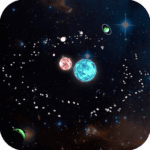
The star, neutron star and black hole stages change the feel of the game. Your pull becomes strong enough to pick up debris without steering precisely, and threats become rare. This part is more relaxed and more about seeing how far the scale goes. It is also the point where the game begins to look like a proper solar system builder rather than a survival exercise, with smaller bodies visibly falling into orbit around you before they are absorbed.
Reaching black hole stage is the natural end. Most people who get there restart to try a faster route, or simply to see the early stages again with the benefit of knowing what everything is.
Mobile and Desktop Differences
On desktop the mouse gives precise, small corrections, which helps in the crowded early phase. On a phone, drag steering is coarser but the touch screen makes it easier to make quick, decisive turns. Neither is clearly better. A landscape phone or tablet works best because it shows more of the surrounding space and gives you earlier warning of what is coming.
Why It Sits Well Next to Solar Smash
Solar Smash is about the end of a planet. myDream Universe is about the beginning of one, from the first rock to the last collapse. Playing them back to back gives you both halves of the same idea, and the calmer pace of this one makes a good change after a few rounds of throwing moons at the Earth.
myDream Universe FAQ
Does it work on mobile?
Yes. Drag anywhere on the screen to steer. A landscape phone or tablet works best because it shows more of the surrounding space.
Can I lose?
Yes. Touch a larger body and you are absorbed, which sends you back to the start. There is no penalty beyond the lost progress.
Is there an ending?
The black hole stage is the final form. After that the game is a free sandbox, and most people restart to try a faster route.
How long does a full run take?
Somewhere between ten and twenty minutes for a careful run that reaches the late stages. Faster is possible once you know the map, but rushing is also how most runs end early.
Is there any saving?
No. Each run is complete in itself. Closing the tab ends it.
Mouse or touch to steer. Fly into anything smaller than you to absorb it. Stay away from anything bigger until you have grown.